Christ Amid Chaos — the Ukrainian Church
It has been more than three years since Russia’s invasion of Ukraine. This invasion has decimated villages, destroyed lives, and torn apart families. Without a doubt, Ukrainians are marked by the deep pain of shared loss and trauma.
However, amid the turmoil, an unexpected community has brought hope and healing to Ukraine’s citizens. The Ukrainian Pentecostal Church (UPC) has picked up the broken pieces left behind by war and responded to a new season of revival and hunger for the gospel.
“No others are reaching into these communities of hundreds upon hundreds except the church,” AG World Missions Executive Director John Easter reflects. “It’s the Ukrainian Pentecostal Church (UPC) in this area that are reaching out and providing meaningful supplies, sharing the gospel, praying for people … giving them an opportunity to know that God still loves them, and that He has not forgotten about them.”
As combat continues to leave deep scars across the nation, local churches provide meaningful, transformational aid and places of refuge in their communities.
FAITH AT GUNPOINT
In February 2022, in the town of Bucha, near the northwest outskirts of Kyiv, Pastor Oleksiy Khyzhnyak and his wife, Svitlana, awoke to the sound of bombing. Oleksiy remembers the chilling message he received over his phone: “The war is here.”
The Russian army planned to use Bucha’s airfield to bring in military transportation and troops. Their initial attack focused on that airfield, just 1½ miles from Bucha Assembly of God, Oleksiy’s church. Oleksiy immediately contacted his congregation, especially those who lived close to the airfield. People began coming to the church for protection.
Seeking safety and sanctuary, 32 people lived in the basement of Bucha Assembly of God for 36 days. Most were non-believers.
The nearby artillery systems and tank brigades fired almost constantly, only taking four 30-minute breaks per day. The church group covered the basement windows and relied on minimal light. They felt relatively secure with their water, electricity, and gas supplies still intact. That would soon change.
A large bomb landed approximately 200 yards from the church. Oleksiy remembers, “We felt our whole building move left.” The electricity went off, but they still had gas to power their oven.
“I remember thinking, It’s fine if there is no electricity. At least we have gas. We’ll survive. In three days, the gas went out,” Oleksiy says.
They found a car battery, hooked it up to a lamp, and that became the only light in the church. With 32 people packed together, the temperature in the dim basement remained about 64 degrees.
By mid-March, all but six people had evacuated from the basement. Among those remaining were Oleksiy, Svitlana, and their 19-year-old son. Their problems would soon become worse.
On March 19, Russian soldiers entered the church and brought the Khyzhnyak family outside. Their son had been texting updates to friends from other countries, including Germany and America. When the soldiers inspected his phone, they found the texts and dubbed him as a spy and a rebel. They led him away from the group, despite desperate pleas from Svitlana.
Svitlana and Oleksiy waited anxiously with the soldiers. Svitlana, under threat by soldiers with guns and with the possibility of looming death, began to pray in tongues. Her Christian sisters gathered around and prayed with her. When they finished praying, Svitlana began to sing Psalm 23, including verses 5-6 (NLT):
You prepare a feast for me
in the presence of my enemies. …
Surely your goodness and unfailing love will pursue me
all the days of my life,
and I will live in the house of the Lord forever.
Oleksiy remembers, “Svitlana could easily have been killed. … When I heard her singing, my legs started shaking.”
Svitlana’s prayer and song deeply affected the soldier in charge.
“Before the situation, he was in command. He was ruling the process. But as Svitlana sang, he stood powerless,” Oleksiy says. The officer then walked away, heading toward their son in a different building.
Unknown to Svitlana and Oleksiy, their son was extremely close to losing his life. As the officers led him away, followed by soldiers with machine guns, they accused him of rebellion and dishonesty. Their son pleaded, assuring them he had done nothing against them, but it was no use. The soldiers gave him one chance for his last words. He began to pray on his knees, “Lord, forgive me.”
Oleksiy retells the pivotal moment: “The officer pulled the trigger, but the gun didn’t fire. Military vehicles packed the street. The officers threatened our son. They told him, ‘We will take you to the woods and tie you to the vehicles to tear you apart.’”
It was this same moment that Svitlana was praying and singing, begging for her son’s safety. Five minutes later — and for unknown reasons — the Russian soldiers released their son, telling him, “Go to your parents.”
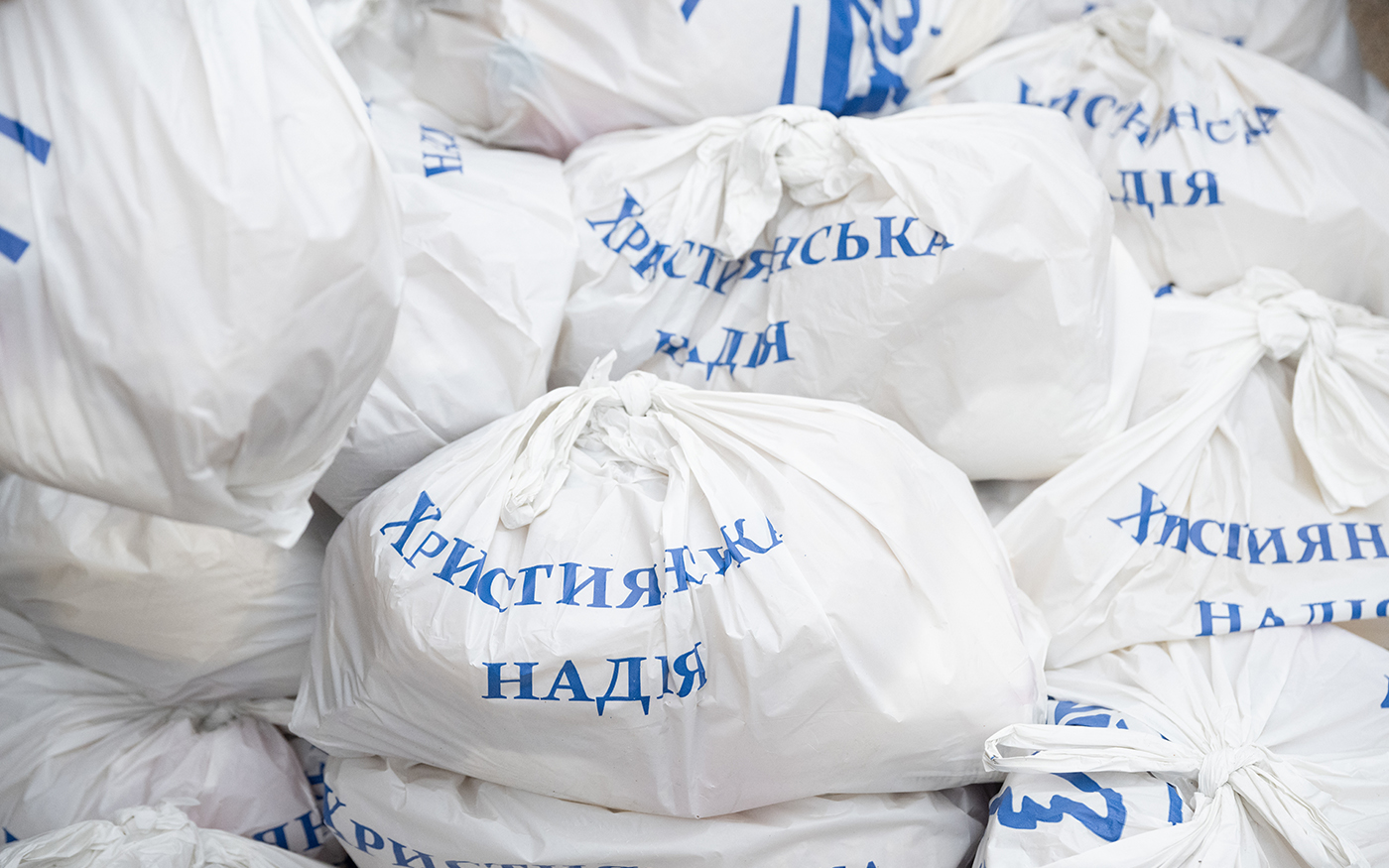
At the end of March, the soldiers left the area. However, with no open grocery stores and few people allowed to come in and out of Bucha, the town’s residents were far from safe. The church became a central point of aid, collecting and distributing food, medical supplies, and more to both Christians and non-Christians.
Oleksiy remembers, “The church started baking bread immediately, and the smell brought hope. After the occupation, up to 350 people attended church every Sunday.”
Bucha Assembly of God is still serving these people today, thankful for God’s protection through extreme situations.
MIRACULOUS SAFETY
Vorzel Pentecostal Church is nestled in Vorzel, a small town on the outskirts of Bucha. Many years ago, a non-Christian building developer received a message in a dream: Find a man named Mykhailo Panochko and build churches for him. The developer discovered that Panochko was the senior bishop of the Ukrainian Pentecostal Church.
At the time, the church was in the middle of a project to build 400 churches by 2020. The developer decided to build 100 of those, including what would become Vorzel Pentecostal Church.
Volodymyr Velykiy, Vorzel Pentecostal Church’s pastor, comes from a long line of Pentecostal pastors — at least four generations of his family have answered God’s call to ministry.
Volodymyr planted Vorzel Pentecostal Church and saw it partially built before the war began. However, he had to flee with the onset of the Russian invasion. He returned to Vorzel in spring 2022 and resumed work in the church.
As combat intensified, no government authorities or charities provided aid in the Vorzel area. However, believers in western Ukraine sent supplies to the front lines, allowing church staff to distribute and deliver relief to nearby residents.
“The church turned into a humanitarian hub,” Volodymyr explains. “There were days we served 700-800 people.”
Because of the invasion, 630 religious sites in Ukraine have been damaged or looted. This includes 75 damaged and 12 Ukrainian Pentecostal Churches destroyed. As with hundreds of other religious buildings, the war left its mark on Vorzel Pentecostal Church. Russian helicopters shot two rockets into the church’s front entrance. The projectiles came through the wall but miraculously did not explode.
God provided protection through the immense danger surrounding Vorzel Pentecostal Church. His hand remains on them to this day.
In December 2022, less than a year after the occupation of the region began, the construction crew completed the building, and the church held a dedication service.
“It was packed with unbelievers,” Volodymyr remembers. “Even today, if you come here on Sunday or Wednesday, you find it’s packed with people.” The church is preparing to begin work on another site, further expanding their ministry.
The influx of people in both Bucha Assembly of God Church and Vorzel Pentecostal Church is not unique. Though the war has brought extensive pain, it has also brought a tremendous openness to the gospel.
Volodymyr Bobyk, Evangelism Department director of the Ukrainian Pentecostal Church (UPC), has witnessed this phenomenon.
He explains, “We want all our precious people in this country, from children to the elderly, to sense the beauty of belonging to the family when they meet somebody from the local church. One of our messages to internally displaced people in the cities and towns around Ukraine is this: If you do not find any place where your soul feels comfortable, come to the church.”
SERVING THE UNSEEN
When Russia invaded Ukraine, many people fled to bordering countries. Others, however, sought refuge in a safer place inside Ukraine. Many of the innocent victims of war are children. How do you minister to those who have experienced trauma because of the ongoing war?
Gerald Dollar, an AGWM global worker, has remained in Ukraine.
“One of the greatest needs is the restoration of families and relationships,” Dollar says. “Many kids haven’t seen their fathers for two or three years. Some kids will never see their fathers because they’re dead.”
The profound loss experienced by these children calls churches and believers to respond.
Over the past two years, the Church has served people in village after village by bringing food, clothing, supplies, and toys for the kids. Dollar and other church leaders brought children from some of these villages to a camp in the central region.
“We were able to pour into their lives at this camp,” Dollar says.
The Ukrainian Pentecostal Church works alongside organizations like Save Ukraine to rescue abducted Ukrainian children. Local churches provide trauma care to help mothers and children. The ravages of war have been especially difficult for mothers with young children.
One global worker explained, “Everyone has a son, brother, relative, or knows someone experiencing trauma. We knew trauma would affect our people.” They need the Church to respond so that many may experience God’s love and come to know Christ as Savior.
War has not stopped the church in Ukraine from ministering to the smallest and unseen.
LOOKING TO THE FUTURE
The war has left an imprint on Ukrainians that will remain for generations. No one has escaped its reaches.
Anatoliy Kozachok, senior bishop of the Ukrainian Pentecostal Church (UPC), explains, “When you are in a war zone, you are overwhelmed with the pain and suffering and loss of blood. … Our minister of healthcare recently stated that about 15 million people already need post-trauma help.”
Serving Ukraine’s traumatized citizens is one of the UPC’s focuses as they look toward the future. To this end, they have developed a department for post-war trauma and are currently training and certifying caregivers to meet the psychological and emotional needs of communities across Ukraine. This endeavor is turning every Pentecostal church into a recovery center. They are also prioritizing pastoral care, routinely holding special retreats for pastors and ministry leaders that allow recovery in peaceful regions.
Despite the nation’s unimaginable struggle, the UPC continues to send missionaries into the world.
“We want to change the local church from a church with a mission team or mission ministry or mission department to a mission church,” shares Oleksandr Hryhorchuk, UPC’s Mission Strategic Initiative coordinator.
In addition to the diaspora churches planted by displaced Ukrainians in 19 European countries, the UPC has churches in 14 other countries around the world.
“There are very few churches in the history of 2,000 years of Christianity that are willing to continue sending missionaries in the midst of their nation being in war,” says John Easter, AGWM executive director. “It would be very easy, because of the war, for them to say, ‘We have enough crises. We do not have the resources to send missionaries.’ They truly have a Kingdom mindset. I’m incredibly inspired by the faith of their leadership.”
The current situation in Ukraine is volatile. The outcome of the war will change the way the UPC works in the future.
“If by any chance — forbid them, Lord — Ukraine is occupied by the Russians, all evangelical churches will be shut down,” Kozachok states, the emotion clear on his face. “Pastors will be put in prisons or kicked out of the country.” Torn between the yearning for peace and the desire for victory, Kozachok asks for prayer for wisdom and for all those who are involved in this conflict.
In the face of this uncertainty, the strength of the Ukrainian Pentecostal Church is tremendous. Despite their own losses and psychological pain, they have turned a time of tragedy to good, bringing the gospel to Ukrainians in a meaningful way. They do not evangelize with words but show Jesus’ love by acting as His hands and feet in the trenches of war.
One thing is certain: No matter the outcome of the war, the gospel will live on in Ukraine.